A STEP BACK TO MOVE FORWARD
Agriculture means, in its deepest sense, the art of cultivating the land. It is not only about producing food, but about a body of knowledge and practices handed down through generations to obtain from nature the sustenance and resources necessary for life.
During the Middle Ages, around 95% of the population lived and worked in the countryside. People followed the rhythms of the seasons and worked in harmony with nature, creating an almost sacred bond. This is how agriculture was practiced for millennia. That ancestral balance, however, was broken only a few decades ago.
In the 1950s, that connection was severed. The industrialization of the countryside brought mechanization and the massive use of fossil fuels, synthetic fertilizers, herbicides, and pesticides. The art of cultivating the land was abandoned, and we stopped talking about resources and began talking about inputs.
The consequences of this rupture are now obvious and alarming.
The result of industrial agriculture is devastating. According to the FAO (Food and Agriculture Organization of the United Nations), we lose up to 30 tons of fertile soil per hectare each year, while nature needs more than three hundred years to regenerate that same amount. A shocking figure if we consider that soil health is directly linked to climate change and therefore to our lives. And the most surprising thing is that the solution to this problem is not far away: it is right beneath our feet.
Healthy soil can store more carbon than all the trees on the planet combined. In addition, it is more fertile, protects against pests and diseases, and holds water more effectively—something crucial in a world increasingly affected by drought. This is why soil regeneration is not only an agricultural issue but also a climatic and social one.
Currently, intensive agriculture is responsible for more than 30% of global greenhouse gas emissions. And yet the solution lies literally at the foundation of everything: the soil. If each year our soils increased their carbon content by just 4%, we could offset a significant portion of those emissions. To achieve this, we do not need to invent anything new: we simply need to recover practices that have already proven their effectiveness.
It is time to stop seeing soil as a simple mechanical support. Soil is a living organism: a complex network of microorganisms, roots, earthworms, insects, and fungi that, in symbiosis, sustain plant and animal life, including our own.
All the knowledge, philosophy, practice, and examples of sustainable agriculture have existed for centuries. In 1975, Masanobu Fukuoka revolutionized agricultural thought with a radical proposal: cultivating with minimal intervention and maximum respect for natural cycles. His work inspired what we now call Regenerative Agriculture, an approach that seeks to restore natural ecosystems through practices such as CO₂ capture, crop diversification, rational pasture-based livestock management, permanent vegetation cover, zero tillage, drastic reduction of inputs, and landscape design for water retention.
This approach is not theory: it is already being successfully applied on various farms around the world.
A notable example in Spain is Finca Planeses, in Girona. In 2014, researcher Marc Gràcia and the public research center CREAF launched the LIFE Polyfarming pilot project there. The farm, then abandoned, became a living laboratory demonstrating that an integrated agro–silvo–pastoral management system—meaning a production model that simultaneously creates synergies between three elements: agriculture (crops), silviculture (trees, forest, or woody plants), and pastoral or livestock activity (grazing animals)—helps improve environmental, social, and economic sustainability in a high-mountain Mediterranean setting such as La Garrotxa.
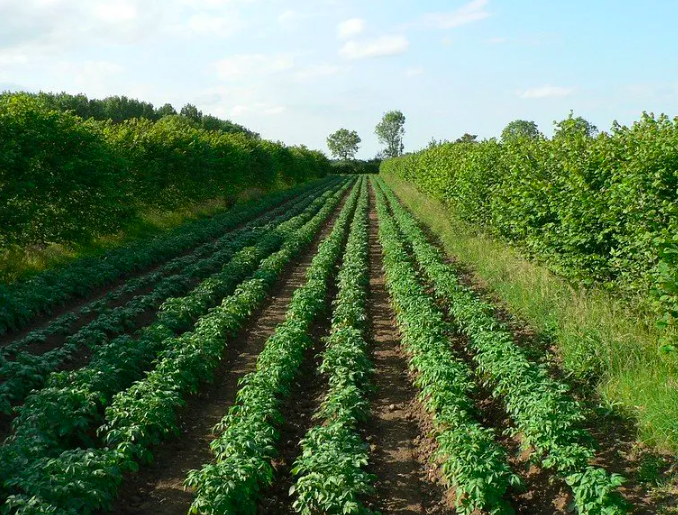
Example of agroforestry.
But it is not the only reference: in Andalusia, too, we find inspiring experiences.
A closer example for us is Olivar Valle del Conde, in Córdoba: the most sustainable olive grove in Spain (according to AEMO, the Spanish Association of Olive Municipalities, 2024). In a landscape very similar to ours, dominated by steep slopes, they have achieved an increase of between 4% and 7% in soil organic matter. This has been possible thanks to sheep grazing, the creation of closed ecosystems using pruning residues, compost, and manure, and the use of permanent vegetation cover with native species that increase biodiversity, capture carbon, and reduce inputs. Today this olive grove is a reference center, scientifically recognized as an example of best practices in mountain olive groves.
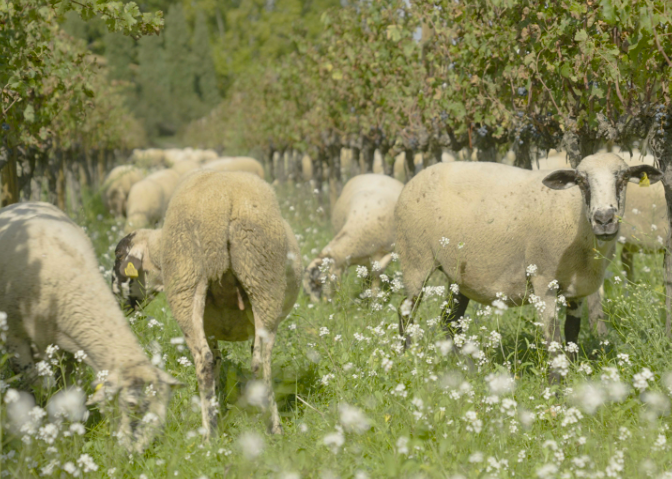
Sheep grazing in the vineyard.
These results show that another agricultural model is possible: more fertile, more resilient, and more just.
Ultimately, the results are visible: more fertile and resilient soils, rich in microorganisms that work with the roots; true sponges capable of retaining water and capturing carbon. The exact opposite of industrial agriculture, which has treated soil as something inert, subjected to monocultures and petrochemicals that have repeatedly destroyed its complex vital architecture—and without that structure, life on this planet would not be possible.
Economic data also confirms the value of this paradigm shift.
Livestock farms that have adopted holistic grazing models have reduced their costs by up to 50%, by no longer depending on external inputs and by feeding their livestock with regenerated pastures grown in the very place where the animals graze.
But this path will only be viable if we walk it together, sharing knowledge and resources.
It is about regenerating nature to produce healthy food, working with soil fertility in favor of life and not against it.
No profound change is achieved in solitude. Sharing knowledge, resources, and collective efforts is another fundamental key. Today, networks such as the Iberian Network of Regenerative Agriculture, the Allan Savory Institute, CREAF, Polyfarming, and many others collaborate with universities and institutions, spreading experiences and knowledge to anyone who wants to participate in this change, because they all share a common conviction: the only way to move forward is to take a step back and recover the art of cultivating the earth.
Ana García